

Wind Lidar: Large-Scale Deployment of Wind Lidar
Download PDFObjectives
Since 2022, the aim of IEA Wind TCP Task 52 has been to support the large-scale deployment of wind lidar (Light Detection And Ranging), and to connect industry and academia to provide the most innovative solutions and application-oriented training for future experts.
Task 52 kicked off in May 2022 as the relaunch of its predecessor Task 32, which in the last 10+ years had supported successfully international collaboration on different wind lidar related topics and applications. Task 52 builds on these achievements, not least by leveraging the existing network and community, but at the same time by further ensuring wind lidar is used by industry, hence supporting the deployment of onshore and offshore wind.
Task 52 participants are collaborating on research to make wind lidar the superior and preferred wind measurement tool for wind energy applications. The vision is to make wind lidar become user-friendly in order to provide advantages that enable the deployment of wind energy. Four central themes have been identified, each with dedicated deliverables targeted within the 4-year period of the current Task phase:
- universal inflow characterisation,
- replacing met masts,
- connecting wind lidar, and
- accelerating offshore wind deployment.
Within these four themes, nine working groups have formed, each focusing on one technical deliverable and inviting all confirmed Task 52 members to contribute and participate.
Participation
By the end of 2025, in total 15 countries have signed up for participating in Task 52 with numerous institutions and companies having joined the individual Task 52 working groups – see Table 1.
| No. | Country or Sponsor Member | Institutions/Companies |
|---|---|---|
| 1 | Austria | Energiewerkstatt, EWS Consulting |
| 2 | Canada | Nergica, UL Renewables, DNV |
| 3 | China | Goldwind, Windey, KC Winden, Movelaser, Leice, CRRC, Envision, HEAG, Shanghai Jiao Tong University, Ocean University of China |
| 4 | Denmark | DTU, Metek Nordic, SGRE, Peak Wind, COP, Ørsted, Vestas |
| 5 | France | IFPEN, Vaisala, Lumibird, EDF, Total Energies, Akrocean, Epsiline, Valemo |
| 6 | Germany | Fraunhofer IWES / IEE, University of Kassel, FUAS, DNV, EnBW, SGRE, University of Stuttgart / SWE, DWG, Vattenfall, Enercon, OWC, sowento, Abacus Laser, GE, IAV, Ramboll, Leonardo, enerlace, UL International, University of Oldenburg / ForWind, DWD, Nordex, MUAS, Ge:Net, PAVANA, RWE |
| 7 | Greece | 2en |
| 8 | Japan | Mitsubishi Electric, AIST, Greenpower, Shimizu Corporation, JRE, Winc, MetroWeather |
| 9 | Korea | Webons, Kyungpook National University, Kier |
| 10 | Netherlands | TNO, TU Delft |
| 11 | Norway | Fugro, Equinor, UiB |
| 12 | Spain | Enel, Eolos, UVP, Tecnalia |
| 13 | Switzerland | Meteotest, Meteo Swiss |
| 14 | UK | Oldbaum Services, Wind Farm Analytics, ZX Lidars, University of Edinburgh, Renewable Dynamics, Blue Ocean Consulting, Black and Veatch, SSE, Wood PLC, Venterra |
| 15 | US | NREL, Arcvera, PNNL, SGRE |
Progress, Results, and Impact in 2025
Over the last two decades, lidar has become a standard technology as a measurement tool, both in the wind industry and in wind energy research. Task 32, focusing on the technology and its application was already initiated in 2012, and continued throughout three phases. Initially, the focus was on the technology itself, later switching to the barriers hindering its use and application, and, finally, the mitigation of these barriers.
By the final phase of Task 32, measuring wind using lidar had largely been accepted in the wind industry. In many cases, lidar was proven to be a better and more suitable solution compared to measuring with the traditional anemometers installed on meteorological masts.
However, as the lidar market has developed, new challenges have arisen, such as the handling of large volumes of lidar data, training of a sufficient number of lidar experts, and the need for standardised methods for carrying out and using the measurements. Considering these challenges, Task 52 pursues the mission of collaborating internationally on research, to make wind lidar the best and preferred wind measurement tool for wind energy applications.
Key objectives of Task 52 are:
- Support large-scale deployment of wind lidar by addressing key themes and achieving relevant deliverables,
- Integrate both industry and academia for most innovative solutions and application-oriented training of young researchers, and
- A strong collaboration with other Tasks within the IEA Wind TCP to share knowledge and make use of the related synergies.
The technical activities in Task 52 are organised into individual working groups, each initiated and responsible for one planned deliverable of the overall work plan. In 2025, the last of the nine working groups was finally kicked off, i.e., the working group on Floating Lidar Systems (FLS) targeted at providing a state-of-the-art review of this specific technology by the end of the Task. Key topics of the working groups, organized under four central themes are as follows:
- Lidar turbulence measurements and lidar-assisted control (as part of theme "Universal inflow characterisation")
- Lidar in complex (and slightly complex) terrain and in cold climate (theme "Replacing met masts")
- Digitalization and lidar ontology (theme "Connecting wind lidar")
- Scanning lidar offshore and floating lidar systems (theme "Accelerating offshore wind deployment")
In parallel with the working groups, further Task 52 activities were also organised and carried out in 2025:
A series of lunch seminars was run for the third time – after the former editions in 2023 and 2024. Over five consecutive days, online seminars were held at lunchtime (CET), highlighting five different focus topics of Task 52 with two invited presentations each. Speakers were drawn from both academia and industry, to ensure both perspectives were represented. Presentations were again also shared in the Task 52 community on Zenodo [1].
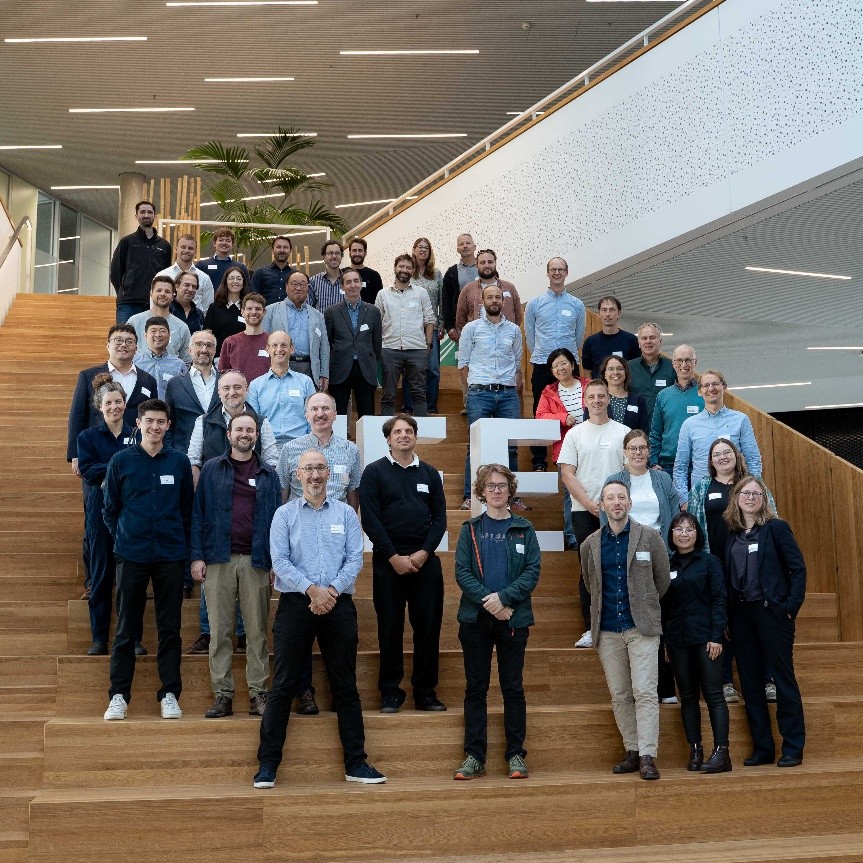
The General Meeting of Task 52 in 2025 was held as a 2-day in-person event hosted at the Fraunhofer IEE premises in Kassel (figure 1). It was attended by about 45 participants discussing the Task 52 themes and topics in various sessions and formats [2]. The first day was focused on technical updates from academia and industry perspectives, including an interactive matchmaking session to identify key R&D gaps. The second day opened with a panel discussion on technology challenges and new solutions with the participation of several lidar Original Equipment Manufacturers (OEMs) sharing their latest developments and concerns. For the rest of the day, participants discussed the opportunities of a possible extension of Task 52 after its current scheduled end in 2026.
Highlights from 2025
- Working Group activity on Ground-Based Lidar in Complex Terrain was concluded with an in-depth presentation and discussion of the results at the Task 52 General Meeting 2025 – see also [3]. In an extensive data study, the working group had collected 83 lidar-mast datasets from about 50 sites. In summary, it could be concluded that the stochastic error of the comparisons is almost unchanged between simple and complex terrain. The systematic effect of terrain curvature on wind speed measured by lidar can be derived from the respective geometries. Though there are also imperfect and/or peculiar sites, the overall dataset yields consistent results.
- A joint mini-symposium ("Lidars In and Out of Simulations") with Task 57 was prepared and held at WESC 2025. This activity has been initiated in close collaboration between the Task 52 Operating Agent and US representatives, as a follow-up activity to the Task 52 side event at NAWEA WindTech 2024 and as blueprint for further joint events.
- The strategic liaison between Task 52 and IEC 61400 MT50 has been further established with a joint seminar (as part of the Task 52 Lunch Seminar Series [1]) and an in-person workshop that has been planned and prepared for January 2026. With this, it is ensured that Task 52 continues to give key input to the normative standardization of wind lidar application within the IEC maintenance team.
Next Steps
The first phase of Task 52 will be concluded in 2026 with the completion and publication of the key technical deliverables of all still active working groups. Also, Task 52 plans to host another edition of the Lunch Seminar Series, for presenting some of the obtained result and discussion further challenges and remaining R&D gaps, as well as a General Meeting to wrap-up the current Task activities and once more provide a forum for all involved stakeholders.
References
- Gottschall, J. (2025). IEA Wind Task 52 Lunch Seminar Series (30 June - 4 July 2025). Zenodo. https://doi.org/10.5281/zenodo.16170992
- Gottschall, J., & Sargin, O. (2025, Dezember 18). Minutes from IEA Wind Task 52 General Meeting 2025. https://doi.org/10.5281/zenodo.17981014
- Stökl, A. (2025, Dezember 18). Lidar in Complex Terrain - Results of the Task 52 Working Group #3. Zenodo. https://doi.org/10.5281/zenodo.17981116
- Gottschall, J. (2025). WESC 2025 Mini-Symposium MS#01.8 "Lidars In and Out of Simulations – a collaboration between IEA Tasks 52 and 57". Zenodo. https://doi.org/10.5281/zenodo.16173523
Task Contacts
Julia Gottschall, Fraunhofer Institute for Wind Energy Systems IWES, Germany (Operating Agent)
julia.gottschall@iwes.fraunhofer.de; ieawind.task52@iwes.fraunhofer.de
Websites:
https://iea-wind.org/task52/
https://www.linkedin.com/showcase/iea-wind-task-52/
https://zenodo.org/communities/ieawindtask52/