
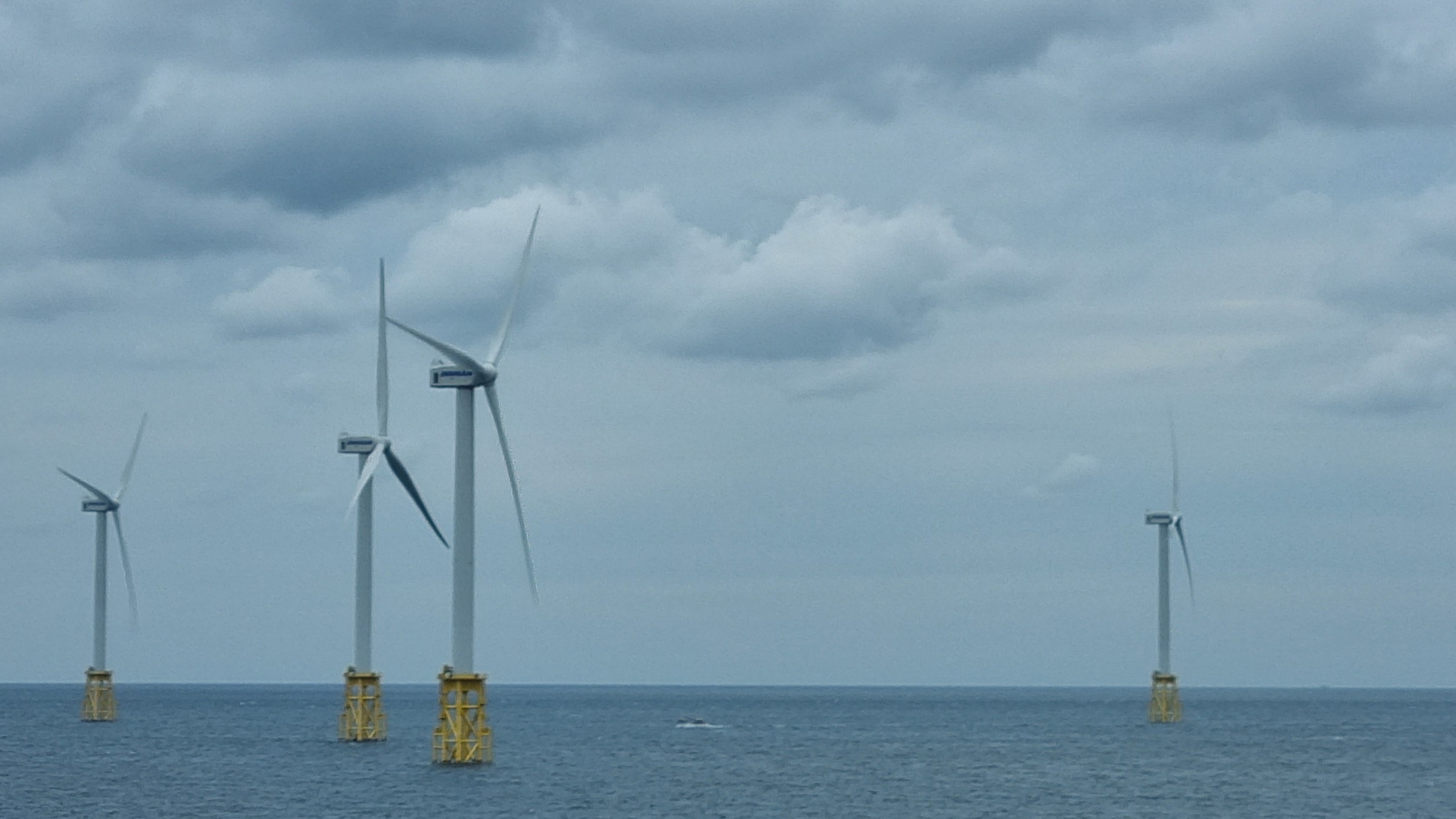
Hallim Offshore Wind Farm (Jeju, Korea)
South Korea
Download PDFIntroduction
Korea’s new wind power installations in 2025 reached 250 MW, representing an 8.7% increase compared to the previous year (230 MW). Although wind power deployment in Korea is still relatively limited at present, according to the Korean government’s announcement, the deployment pace is expected to accelerate steadily, with the total installed capacity projected to reach 37 GW by 2035. This corresponds to approximately 14.8 times the current level.
To support this expansion, Korea is investing KRW 69.8 billion (EUR 40 million) annually in wind power R&D programs.
| Total (net) installed wind power capacity* | 2.49 GW |
| Total offshore capacity | 0.36 GW |
| New wind power capacity installed | 0.25 GW |
| Decommissioned capacity (in 2024) | 0 GW |
| Total electrical energy output from wind | 3,664 TWh |
| Wind-generated electricity as percent of national electricity demand | 0.62 % |
| Average national capacity factor** | 17 % |
| Target | 12 GW (onshore) & 25 GW (offshore) by 2035 |
| National wind energy RD&D budget | KRW 69.8 billion (EUR 40 million) |
Highlights
- In 2025, the Korean wind power market reached 250 MW of new installations and 2.5 GW of cumulative installed capacity.
- Of Korea’s cumulative wind power capacity, onshore wind accounts for 85% (2.2 GW), while offshore wind accounts for 15% (0.3 GW).
- Korea’s onshore wind power target is planned to expand to 6 GW by 2030 and 12 GW by 2035.
- Offshore wind power capacity is planned to increase to 10.5 GW by 2030 and 25 GW by 2035.
Market Development
Targets and Policy
- The Ministry of Climate, Energy and Environment announced its Onshore Wind Power Expansion Strategy in December 2025, setting targets to increase onshore wind capacity from the current 2.2 GW to 6 GW by 2030 and 12 GW by 2035. In parallel, the Ministry aims to reduce the levelized cost of electricity (LCOE) for onshore wind from the current KRW 180/kWh (EUR 0.10) to KRW 150/kWh (EUR 0.087) by 2030 [1].
- In addition, the Ministry of Climate, Energy and Environment released the Offshore Wind Infrastructure Expansion and Deployment Plan in December 2025, announcing plans to expand offshore wind capacity from the current 0.3 GW to 10.5 GW by 2030 (including projects under construction) and 25 GW by 2035. The Ministry also established targets to lower the offshore wind LCOE from the current KRW 340/kWh (EUR 0.20) to KRW 250/kWh (EUR 0.15) by 2030 and further to KRW 150/kWh (EUR 0.09) by 2035 [2].
Progress and Operational Details
- In 2025, newly installed wind power capacity in South Korea reached 250 MW, of which 60% was onshore wind and 40% was offshore. Cumulative installed wind power capacity reached 2.5 GW, comprising 85% onshore and 15% offshore. As a result, newly installed capacity in 2025 accounted for approximately 10% of the cumulative installed capacity. The share of offshore wind within the overall wind power portfolio has also continued to increase.
- Wind power accounted for only 0.62% of South Korea’s total electricity generation in 2025, indicating that the sector remains at an early stage of expansion, despite continued market growth.
- In 2025, newly issued Electricity Business Licenses (EBLs) for wind power projects totaled 6.1 GW. The vast majority of these licenses, representing 92%, were granted to offshore wind projects, while only 8% were issued for onshore wind projects.
- Cumulative Electricity Business Licenses issued for wind power projects reached 45.8 GW by the end of 2025. Among this total, offshore accounted for 78%, while onshore represented 22%, demonstrating the strong policy and market focus on offshore wind development in South Korea.
Matters Affecting Growth and Work to Remove Barriers
- Wind farm development in South Korea has been led primarily by the private sector, with individual developers independently carrying out projects. Project implementation was often delayed because developers were required to obtain complex permits and approvals under 28 different laws and regulations.
- With the enforcement of the Offshore Wind Power Special Act in March 2026, a government-led planned site designation system was introduced. Under this framework, the government first secures local community acceptance in areas surrounding prospective wind farm sites and subsequently selects private developers through a competitive bidding process.
- In addition, a one-stop-shop system has been introduced to streamline the permitting and approval process by integrating multiple administrative procedures into a single channel. This new approach is expected to significantly shorten the overall wind farm development period.
RD&D Activities
National RD&D Priorities and Budget
- The annual government budget allocated to the wind energy sector in South Korea amounts to approximately KRW 69.8 billion (EUR 40 million).
- This budget is distributed across four main areas: wind turbine and component development, wind power installation and construction, floating offshore wind technology, and wind farm operation and maintenance (O&M).
National Research Initiatives and Results
- The project entitled “Basic Design of 20MW+ Class Offshore Wind Turbines Tailored to Domestic Environmental Conditions” is currently underway in South Korea. The project period runs from April 2025 to March 2029, with a total budget of KRW 8 billion (EUR 4.7 million).
- The project focuses on the integrated design of offshore wind turbines rated at 20 MW or larger, including the design of key components such as bearings, blades, and towers.
- The project is being carried out through collaboration among several government-funded research institutes and industry partners. Participating organizations include the Korea Institute of Materials Science (KIMS), the Korea Electrotechnology Research Institute (KERI), the Korea Institute of Energy Research (KIER), and Unison, a wind turbine manufacturer.
Test Facilities and Demonstration Projects
- Through the “Testing Infrastructure Development for Blade Materials” project, new testing facilities were established in October 2024.
- The newly developed infrastructure includes a range of equipment for wind turbine blade testing, such as a CT scanner, a rain chamber, and a high-energy impact tester.
Impact of Wind Energy
Environmental Impact
The Presidential Commission on Carbon Neutrality and Green Growth designated the achievement of the 2035 Nationally Determined Contribution (NDC) targets as part of the national agenda in November 2025. To support this goal, the government plans to expand the cumulative installed capacity of renewable energy to approximately 100 GW by 2030. Through these efforts, South Korea aims to reduce greenhouse gas emissions by 53% to 61% by 2035 compared with 2018 levels.
Economic Benefits and Industry Development
The South Korean government is strengthening technological competitiveness and fostering domestic industries by supporting the development of ultra-large-scale wind turbines and floating offshore wind technologies. In addition, continued support is being provided for export-oriented industries such as offshore wind substructures and subsea cables, which are already recognized as competitive export products.
Next Term
The South Korean government has decided to allocate funding from the National Growth Fund to the Shinan Uido Offshore Wind Project (390MW) in order to accelerate investment in offshore wind power development.
Approximately two-thirds of South Korea’s offshore wind Electricity Business Licenses (EBLs) are concentrated in the Jeollanam-do region. This region was recently integrated with Gwangju and is expected to receive government support amounting to KRW 20 trillion (EUR 11.6 billion). A portion of this budget can be invested in the offshore wind sector.
References
[1] Ministry of Climate, Energy and Environment (December 2025). Onshore Wind Power Promotion Strategy
[2] Ministry of Climate, Energy and Environment (December 2025). Offshore Wind Infrastructure Expansion and Deployment Plan
Authors
Jungchul Choi, Mokpo National University