
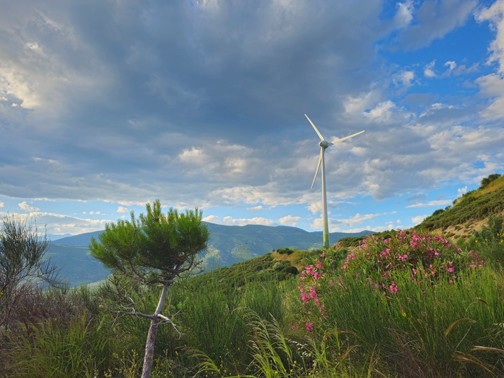
Cover Photo: Wind turbine 800 kW in Central Greece. Source: HWEA / ELETAEN [2].
Greece
Download PDFIntroduction
The total installed wind power capacity in Greece at the end of 2025 reached 5695MW, (6.0% increase compared to the end of 2025). Wind energy is now the second largest domestic energy source for the Greek Electricity system, with PV climbing to the first position due to the increased installation rates in the last two years. Wind energy is estimated to cover 22% of total electricity demand. Total RES share in electricity mix (wind, PV, hydro and biomass) reached 52%.
Annual electricity demand in 2025 showed a small decline (2%) compared to 2024. In 2025, Greece continued to be a net energy exporter with exports reaching 5.4.% of local demand. (table 1).
| Total (net) installed wind power capacity | 5.7 GW |
| Total offshore capacity | 0.0 GW |
| New wind power capacity installed | 0.340 GW |
| Decommissioned capacity (in 2024) | GW |
| Total electrical energy output from wind | 12.2 TWh |
| Wind-generated electricity as a percentage of national electricity demand | 22 % |
| Average national capacity factor | N/A |
| Target | 10.8 GW |
| National wind energy RD&D budget |
Highlights
- Wind energy remains a major domestic contributor to power generation (22% of demand)
- RES share in power generation reached 52%
- Greece net exporter of electrical energy (at 5.4 % of total internal demand)
Market Development
Targets and Policy
In the revised National Plan for the Energy and the Climate [1] as published in September 2024, the 2030 target for the total RES share in energy consumption is set at 45% (up from 37% in the previous draft), which translates into a 77% share of RES in electricity generation. The estimated wind capacity needed by the end of 2030 is 10.8 GW (up from 9.5 GW). Offshore wind is estimated to provide 1.9 GW, while the remaining 8.9 GW will be covered by onshore projects. Regarding onshore wind, the mean annual installation rate achieved in the last years is 300-350 MW per year. The set target is deemed feasible, despite challenges for the local supply chain and financing capacities, but requires a significant speed up in the remaining years to 2023. Offshore wind is a completely new field for Greece and there is a higher uncertainty regarding reaching the target on time.
On the legislative field, a significant development is the adaptation of the European RED III Directive to the Greek legislation. However, concerns were raised from the industry as to whether the overriding public interest principle is sufficiently covered by the approved law.
Currently, there is no support scheme for large scale onshore wind projects. Prices offered for utility scale wind farms in 2022 auctions were 58 euros/MWh. A fixed Feed in Tariff for small commercial projects (up to 3MW) is set at EUR 80 /MWh while energy communities projects can get, under provisions a higher price (EUR 98 / MWh. Considering that mean wholesale electricity price for 2025 in Greece was EUR 104 /MWh, wind electricity fed to the grid even by small commercial wind farms under protected price, is cheaper than the average electricity cost. The increased RES contribution to the electricity mix led to reducing price volatility due to external disruptions (i.e. war in Ukraine, Middle East crises).
For small wind turbines (nominal power less than 60kW), a special support scheme exists, assigning 157 euros/MWh to electricity fed to the grid by wind turbines with nominal power less than 60kW and height above ground less than 30m. Although this scheme has been in place since 2019, the small wind turbine sector is practically non-existent with less than 0.2ΜW of wind turbines in this power range connected to the grid. Main barriers are limited grid availability, high connection costs, and the still demanding licensing procedure.
A draft National Plan for the deployment of Offshore Wind farms was launched in 2023, and sets a target of 1.9GW of offshore wind farms for 2030. However, the draft and its Strategic Environmental Impact Analysis have not been ratified and are still under consultation and negotiations with licencing authorities. The Support scheme for offshore wind farms is also under negotiations with the EU. Limited progress in preparatory actions (planning for offshore field measurements, port infrastructure, etc) has been made.
Progress and Operational Details
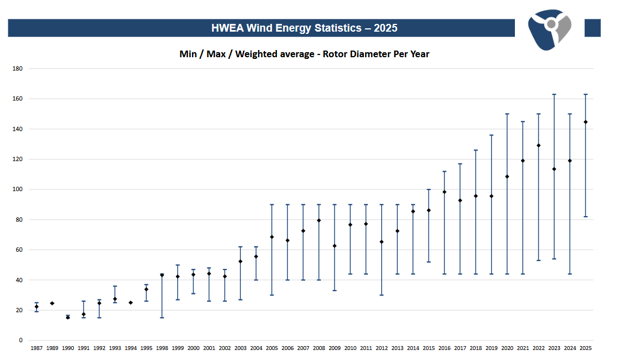
The total installed wind power capacity in Greece at the end of 2025 reached 5695 MW. The new capacity installed in Greece in 2025 was 340 MW, close to the 10-year average (355 MW). A total of 76 new wind turbines with an average nameplate capacity of 4.5 MW were installed. The average name plate capacity increased compared to the previous years (average for 2024 3.2MW), mainly because no wind turbines in the 1MW range being installed in 2025. For the same reason, weighted average rotor diameter also increased to 140m (up from 120m). Figure 1 below shows trends in wind turbine sizes in Greece (source HWEA/ELETAEN, [2].
Following the increase in installed capacity, wind penetration to the electricity system continues to rise in 2025 in parallel with other non-dispatchable RES. Maximum 1-hour averaged wind energy penetration to the main electricity grid was 97.2% (up from 90.4% in 2024). Wind penetration was above 50% for 616 hours while total non-dispatchable RES penetration was higher than 50% for 3335h. Also notable, total RES penetration exceeded total demand for 212 hours (306 h in 2024), making Greece a net exporter of RES electricity [2].
Matters Affecting Growth and Work to Remove Barriers
Licensing: Delays in licensing due to still complicated framework in combination with severe shortages in personnel in the relevant field. A major review of RES spatial planning is expected for next year (2026).
Grid restrictions. Significant grid reinforcing works are in progress on major energy corridors and RES concentration areas. In parallel significant progress is made for the interconnection with the mainland of all major islands of the Greek archipelagos, which currently operate as isolated, diesel-powered grids. The first interconnection line for Crete (400ΜVA) is fully operational since 2021, while the second line (1000 MVA) was put in operation in December 2025, 6 months ahead of schedule.
Interconnections of the remaining major Aegean Sea islands are progressing. Construction work for onshore infrastructure has been awarded, while sea bottom surveys were also made. Links are expected to be operational in 2030, with the Dodecanese islands connected first, and north Aegean Islands following. Apart from greatly reducing the electricity production cost on the islands and reducing dependance on imported fuels, these interconnections are also strategically connected to the RES and offshore wind farm development, having included in their planning additional capacity to accommodate for planned offshore wind farms and other RES in the Aegean Sea.
Increase in RES Curtailment. Another significant trend emerging in recent years is the increase in RES curtailments. RES curtailments rose to 7% of total RES production in 2024, up from 4% in 2024.
Lack of storage capacity. Although the rapid increase of solar capacity in the last years and its inherently correlated production profile is creating surplus energy flows, the severe lack of energy storage capacity exacerbates the problem. Currently, while 15 GW of non-dispatchable RES are operating in the Greek system, only 700MW of hydro pumped storage are available.
An additional 900MW of battery storage is expected to be operational by the end of 2026, while another 4500 MW (3500 batteries and 1000 hydropump) should be expected till 2030. It is crucial to see the storage capacity increasing faster in the next years to cope with the expected increase in RES capacity to avoid unnecessary energy losses.
Public opposition: Interaction between the local public and developers and licensing authorities remains limited. Industry shareholders are active in campaigns aiming to respond to fake news on wind farms and promote environmental, societal and economic positive impacts of wind energy.
RD&D Activities
National RD&D Priorities and Budget
R&D activities in wind energy in Greece are funded mainly through EU and national programs. A major funding tool for applied research in Greece is the Program for Research, Technological Development and Innovation “EREVNO” (co-funded by the Greek state and the European Regional Development Fund). The new period of the EREVNO program was launched in 2024 with an estimated total funding of EUR 300 million for all research areas for the period 2023-2030. Results from the first call are pending.
A non–exhaustive review of demonstration and collaborative R&D projects with Greek participation in wind energy that were active in 2025 is given in the following:
Test Facilities and Demonstration Projects
GREEN ISLAND – Agios Efstratios: The project deals with the conversion of a small, isolated island grid into a RES powered system. Main power sources on the island will be an 800-900kW wind turbine and a 100-200 kW PV array. A 2.5 MWh Li-Ion battery bank is also foreseen for short term energy storage, while thermal storage for district heating will provide load balancing to limit power shredding and medium-term storage. Diesel generators, currently covering the total electricity demand on the island, will be limited to back-up operation only.
After completing successfully an extensive trial period, the Hybrid station is in normal operation since November 2025. Very high RES penetration rates (up to 98.6%) have been achieved on monthly basis, while the Hybrid station operates fully independent covering all loads and grid forming for large continuous periods (> 15 days). (total budget EUR 8.5 million, co-funded by the by the Greek state and the European Regional Development Fund [3].
The TWEET-IE (Twin Wind Tunnels for Energy & the Environment) EU project upgraded wind tunnel testing at the National Technical University of Athens (NTUA). Funded under Horizon Europe, aims to improve measurement conformity, study urban microflows, and optimize wind turbine wake interaction [4]
Collaborative Research
MARINE WIND: Coordination and support action aiming to identify bottlenecks and potential opportunities to strengthen floating offshore wind's technology FOWT role in delivering innovative solutions to system integration, considering how best to integrate such a system by exploring the market, policy and regulations issues, social, financial and techno-economic optimal solutions, and provision for storage and flexibility recommendations [5].
The Research Infrastructure Services for Renewable Energy (RISEnergy) project is dedicated to fostering a long-term, coordinated research effort among leading private companies and research institutions to advance energy technologies within the EU [6].
The Southern European Community for Offshore Wind Energy (SHOREWINNER) project aims to set up and develop a Community of Practice (CoP) based on the cooperation among five Centres of Vocational Excellence (CoVEs) committed to the development of skills, upskilling and reskilling of the workforce, sharing of resources, and achievement of major European goals and priorities. The CoVEs will be created in southern European countries (Portugal, Spain, Italy, Greece and Cyprus) with a promising offshore energy sector [7].
Impact of Wind Energy
Environmental Impact
Wind energy produced 12.2 TWh of electricity in 2024 covering 22% of annual electricity demand in Greece, while offsetting the equivalent of 2.2 million tons of CO2 emissions. The volume of avoided CO2 emissions is equal to the emissions of 85% of private cars circulating in Greece.
Wind energy, like all other RES, is a domestic energy source immune to fossil fuel price volatility and feeds electrical energy to the grid at stable competitive prices.
Economic Benefits and Industry Development
On the local level, 3% of electricity sales by wind farms under support schemes and EUR2/MWh for wind farms selling directly to the market, returns to the local communities as an extra funding to the local administration bodies and direct subsidies to the electricity bills of consumers on the communities hosting wind farms. A total of EUR 41.2 million were distributed in 2025 to local communities through this mechanism (corresponding to the energy produced by wind farms in 2024).
The total value of new wind capacity set in operation within the year in Greece is estimated to be EUR 420 million. By the end of 2025, 1100 MW of new wind energy plants were under construction, all of which are expected to be operational within the next 18 months [2]. On the employment field, wind energy is estimated to support the equivalent of 7100 full time jobs.
The launch of the offshore wind farm development Greece is perceived as an opportunity for development with significant local impact since the domestic maritime and shipbuilding industry capacities and know-how are currently underused. It’s worth noting that, although offshore wind development in Greece is in early planning stage, three companies based in Greece have already substantial activities in the global offshore wind supply chain.
The extensive work currently in progress in the Aegean Sea for the interconnection of islands to the mainland grid, will provide the much-needed grid capacity for the connection of additional on- and offshore wind farms in the Aegean Sea, an area which possesses the best wind potential in Greece. The combined investment related to the major interconnection projects currently in progress or expected to start within the next year is estimated at EUR 2.5 billion.
Next Term
Wind energy is one of the major contributors to the electricity system of Greece, and its importance is expected to be increased in the future, as clearly highlighted in the NCEP.
For wind energy to fulfill these expectations, the following challenges must be addressed, as outlined by all members of wind industry in Greece:
- Implementation of the revised licensing framework to allow for fast deployment
- Deployment of storage capacity
- Application of load demand management procedures
- Offshore wind development
- Local supply chain strengthening and improvement
- End of life issues
- Societal acceptance
References
[1] National Plan for the Energy and the Climate (NCEP – ΕΣΕΚ, https://ypen.gov.gr/energeia/esek/)
[3], aistratis.agenso.gr/
[4] tweet-ie.eu/
[6] risenergy-project.eu/
[7] shorewinner.eu/
Author
Nikolaos Stefanatos, CRES, Greece