
Wind in the heights. (Photo credit: Miguel Angel Cast.)
Spain
Download PDFIntroduction
Renewable based power supply in Spain reached 55.6% of total power consumption in 2025, 1.2 percentage points lower than the previous year. Wind power maintained its position as the largest source of electricity generation in Spain, with a generation of 21.4%. According to the Spanish National Integrated Energy and Climate Plan 2021-2030 (NECP) [5], the government is committed to install about 50 GW of new wind capacity which means about 28.86 billion EUR (30.97 billion USD) to meet European targets for 2030.
The Spanish wind sector installed nearly 1.4 GW during 2025 [2]. In terms of installed capacity, wind power ranked first in 2025 (24.9% of total)
The Spanish government approved the first Offshore Wind Roadmap in 2021. It aims to kickstart the deployment of offshore wind with a view to having up to 3 GW operating by 2030. Given the bathymetry of the seafloor in Spain, floating offshore technology is the most appropriate option.. Ports and shipyards across Spain already play a key role in the rest of Europe. The new Roadmap will stimulate the further development of Spain’s floating wind supply chain.
| Total (net) installed wind power capacity* | 32.1 GW |
| Total offshore capacity | 0.007 GW |
| New wind power capacity installed | 1.42 GW |
| Decommissioned capacity (in 2025) | 0 GW |
| Total electrical energy output from wind | 57.41 TWh |
| Wind-generated electricity as percent of national electricity demand | 21.4 % |
| Average national capacity factor** | 21.3 % |
| Target | 50.26 GW |
| National wind energy RD&D budget | 100 million EUR (117,5 million USD) |
Highlights
- Wind energy was the largest source of electricity generation with 21.4 % share of demand.
- Most of the new onshore wind projects are hybrid and many of the old wind farms are going to be hybridized with solar PV.
Market Development
Targets and Policy
- The government is promoting simplified permitting procedures and regulatory changes (e.g., Royal Decree-Law 7/2025) to accelerate project pipelines and support grid integration.
- Policies are beginning to support repowering (replacement of old turbines with modern, higher-output ones), though industry groups want clearer national frameworks and incentives to scale this up.
- Despite ambitious offshore targets, the sector warns that delays in publishing key regulatory orders and finances for port upgrades are risking Spain losing competitiveness in offshore wind to neighboring countries.
- First competitive offshore wind auction was proposed for 2025, signaling strong policy support for floating and coastal wind development but finally this auction has been postponed to 2026.
- Spanish utilities and developers (e.g., power purchase agreements with major users like the national rail operator (370 GWh/yr), Energy Traders, Data Centers) are increasingly integrating wind generation into broader decarbonization strategies, showing the market adapting to policy direction.
Progress and Operational Details
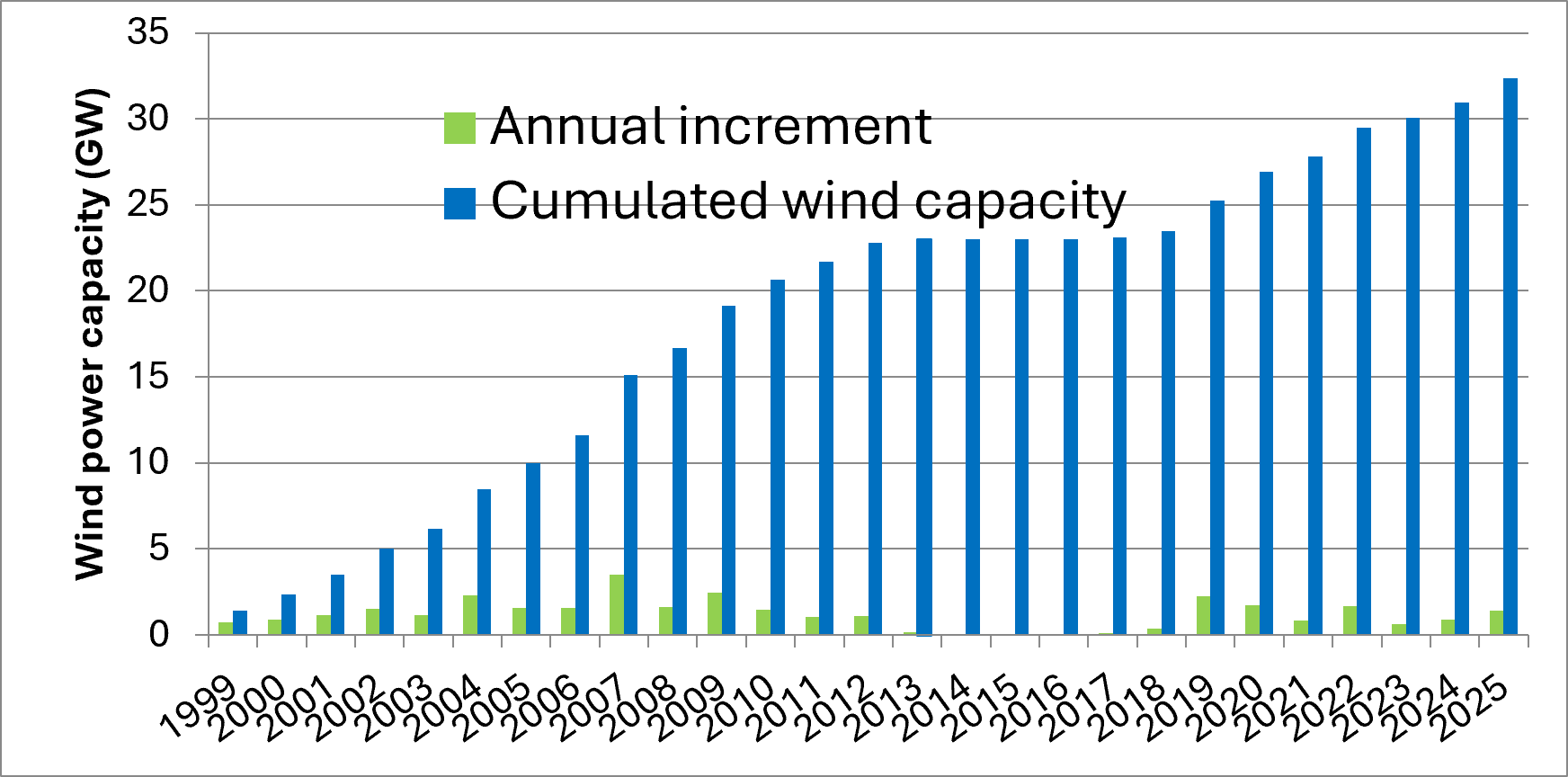
Spain installed 1420.88 MW of new wind power capacity to 32.1 GW (Figure 1) in 2025. These installations included 611 MW in Aragón and 566 MW in Castille León.
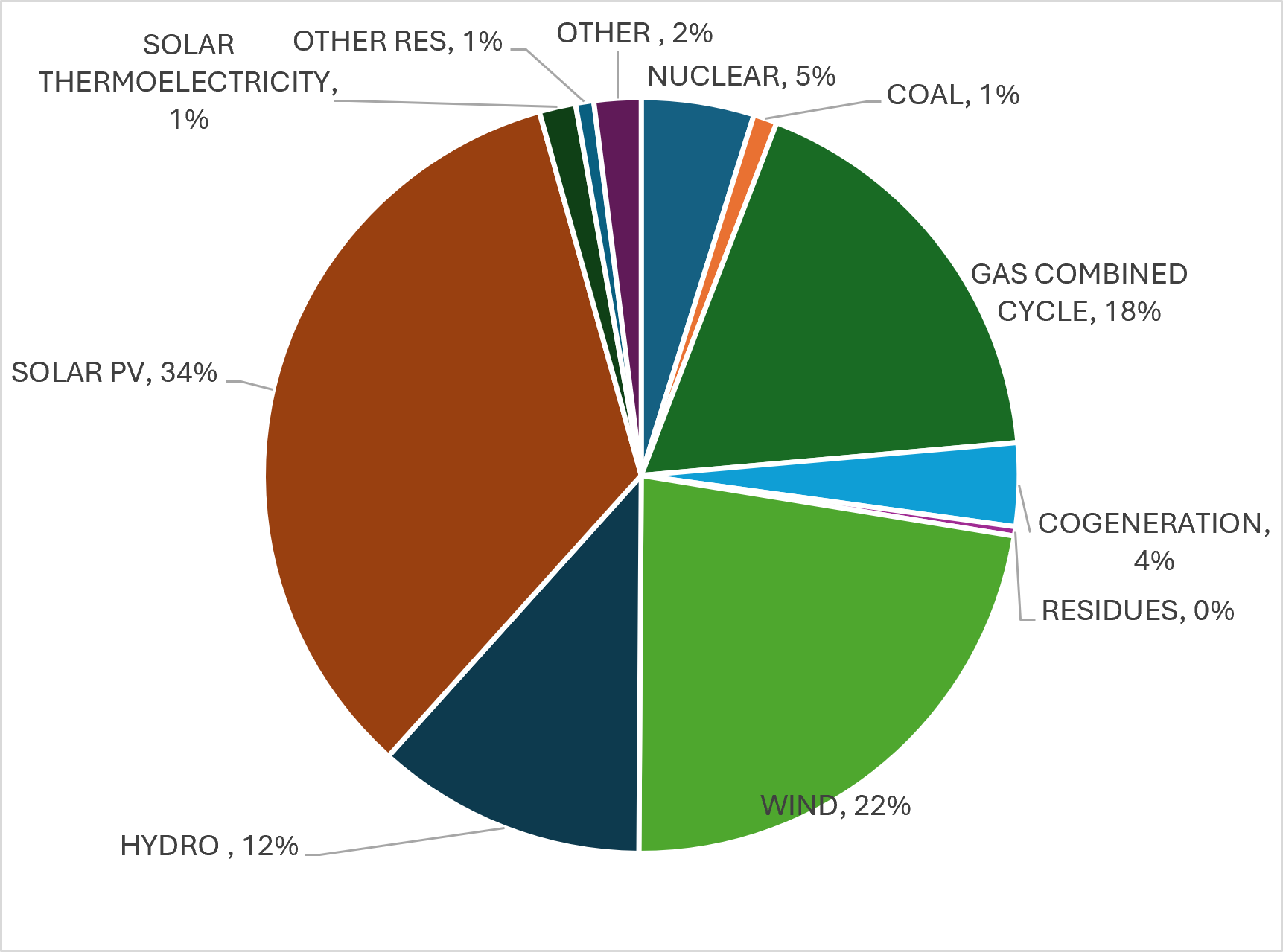
In terms of installed power, wind power represents 22 % of total installed power in Spain (Figure 2). The large increase from 17% in 2024 to 34% in 2025 in solar PV power is remarkable (includes solar PV power in self-consumption applications).
Iberian blackout on April 28th 2025. In the aftermath of that, the so-called ‘reinforced’ scheduling increased gas consumption and decreased RE generation (15% for wind, according to AEE), and represented an increase of 2.34% of the total costs of the Spanish electricity system.
As a result, 2025 has been characterized by the general increase in Technical Restrictions in the Spanish electricity system: the amount of electricity scheduled to address technical restrictions was 31,529 GWh, a 47.1% increase compared to the previous year. Of the total electricity, 83.8% was scheduled for upward regulation. During 2025, the amount of electricity scheduled for upward regulation increased by 39% compared to 2024, while the amount scheduled for downward regulation doubled.
Wind energy was particularly active in the Daily Reference Program of Operation (PDBF), in the Real-time operation, and in Replacement Reserves (RR), Technical Restrictions (TR) and Tertiary Regulation (mFRR).
Matters Affecting Growth and Work to Remove Barriers
- A new type of curtailment is becoming increasingly more frequent; the economic curtailment, that refers to those hours where the market price is very low, zero or even negative. According to data from 2025, 9.1% of the time the prices were zero or negative, and an impressive 30 % of the time, the prices were below 30 €/MWh. This trend is questioning the profitability of renewable energy generation, mainly solar PV, but also affecting wind generation. The average captured price was 63.41 €/MWh for wind and 35.75 €/MWh for solar PV [4].
- Curtailment of energy resources continues to be an ongoing issue within the Spanish electricity network. The total wind power curtailment in 2025 reached 2922 GWh (47% higher than 2024). In 2025, several network nodes located in areas with high wind resources such as Aragón or Galicia have been close to exceed the 5% curtailment threshold recommended by the EU.
- In 2023, the central government developed a tool that allows identifying the areas of the national territory that present the best environmental conditions for the implementation of renewable projects, through a territorial model that groups together the main environmental factors, the result of which is a zoning of the environmental sensitivity of the territory.
- The Royal Decree-Law 8/2023 extended the milestones established in RDL 23/2020: The deadline to obtain the Administrative Authorization for Construction of the project is extended by six months, up to 49 months. In addition, promoters may extend from five to a maximum of eight years the period for obtaining the Administrative Authorization for Exploitation of the project. Finally, the maximum total time to comply with the milestone of obtaining the Definitive Operating Permit for offshore wind farms and pumped hydro power plants becomes nine years.
- Grid access and connection was also modified, to regulate access permits and connection for the orderly boost of electricity demand, among other measures.
RD&D Activities
National RD&D Priorities and Budget
National wind RD&D (Research, Development & Demonstration) activities in Spain are expected to generate major technical and economic benefits by improving wind turbine performance, strengthening industrial competitiveness, and accelerating the energy transition.
From a technical perspective, Spanish wind RD&D focuses on increasing Annual Energy Production (AEP) without proportionally increasing CAPEX, mainly through larger rotor diameters, advanced control systems, digitalization, artificial intelligence, and improved materials. Transport, logistics, and assembly of larger wind turbines, grid integration and participation in electric system operation services and offshore wind energy where both bottom-fixed and floating are also considered relevant RR&D topics. These innovations improve turbine efficiency, reliability, and operational flexibility. Digital monitoring and predictive maintenance reduce downtime and maintenance costs, especially in offshore environments.
Spain does not publish a single consolidated figure specifically labeled “Wind RD&D budget 2025” because, firstly, funding for energy RD&D is considered technology neutral and, secondly, it is distributed across several national and regional RD&D agencies.
The national government investment in wind RD&D ecosystem is estimated to be in the range of €100 million (USD 117,5 million).
National Research Initiatives and Results
- The R3POWER project is a comprehensive response to the challenge of sustainable repowering, combining the reuse of existing infrastructure, advanced material recycling, zero-waste revaluation, and the development of new circular materials.
- The CICLO project aims to investigate new technological solutions for reuse, recycling, including pyrolysis, solvolysis and biorecycling, and the development of intermediate (SMC, BMC and textiles) and final products to promote the circular economy of composites in the renewable energy sector.
- The VAIANA Project aims to explore large‑scale integration of offshore wind with hydrogen production, addressing grid and sector coupling challenges.
- The ChirUP Project: Enhances scientific knowledge and training related to energy transitions including, implicitly, variable renewables and integration technologies.
- The Green H₂ Wind Surplus Storage (IDOM concept design).
- Hybridisation + Storage (100 MW/200 MWh) with Wind Plants (Iberdrola & Ingeteam)
- Nadara Hybrid Solar (205 MW)‑Wind (202.5 MW) Build‑Out (2025 start)
Test Facilities and Demonstration Projects
- The PRIMAVERA demo project developed by EnerOcean, is scheduled to start to generate power in the Granadilla Port in Tenerife island by the end of 2026. It will be the world's first 2 x 5.5 MW commercial-sized floating wind platform to generate renewable energy in a commercial port, while also providing a full lifecycle training and innovation center.
- The PLENCAT platform led by IREC will be a floating marine energy laboratory in the Mediterranean Sea used to study the behaviour of different technical components and systems to advance and validate floating wind power, other marine energies, monitor marine ecosystems and other environmental, climate or biodiversity studies.
Collaborative Research
Spain is participating in several IEA wind TCP Tasks:
- Task 65 WindSCOUT,
- Task 63 TWENTY-FIVE,
- Task 56 OC7, Task 41 Distributed Wind,
- Task 44 Flow Control in Wind Farms,
- Task 46 Erosion of wind turbine blades,
- Task 48 Airbornes,
- Task 52: Large scale LIDAR deployment,
- Task 58 Offshore Wind Centers and
- Task 59 WREN
Impact of Wind Energy
According to the AEE figures [3], in 2025 wind power reduced the market price by 14 €/MWh. Wind power has helped lower the average price of electricity by 18 percent. The wind power generated that year resulted in an estimated savings of 3,904 million euros in the economic value of the energy traded on the wholesale market.
Environmental Impact
According to AEE Annual report [3], during 2024, wind energy helped abate the emissions of 30.8 million tons of CO2.
- Some environmental legislation aimed at bird protection has raised concerns that stricter collision-impact rules could slow down or complicate approvals for new wind farms.
- Spain launched recycling and sustainability efforts (e.g., the RENOCICLA plan) targeting the reuse of wind turbine blades and other renewable components, improving long‑term environmental performance.
- EnergyLOOP – Wind Turbine Blade Recycling Plant (Navarra). First facility on the Iberian Peninsula dedicated to recycling wind turbine blades — a key challenge for offshore and onshore wind sustainability and circular economy.
Economic Benefits and Industry Development
- Community energy projects across Spain, where cooperatives use local wind/renewable infrastructure to provide affordable clean power and tackle energy poverty.
- In 2025, Galicia’s social acceptance of wind energy has been moving from conflict toward collaboration, thanks largely to local benefit sharing and supportive judicial decisions.
The Spanish wind sector employs more than 37,000 people annually. More than 287 companies work in Spain in 16 of the 17 Autonomous Communities. Wind Energy directly and indirectly contributes to 0.25% of the GDP 3.27 billion EUR. The sector exportations (wind turbines and components) accounts for around 1.95 billion EUR, in 2024, being in fifth position in the world after Germany, Denmark, India and China [3].
There are currently 22,433 wind turbines installed in 1,454 wind farms in 868 municipalities, occupying only 0.017% of total Spanish surface.
The main wind turbine suppliers in 2024 were GE RE (337 MW, 28.4%), Siemens Gamesa ER (230 MW, 19.4%), Vestas (205 MW, 17.3%), NORDEX-ACCIONA Wind Power (203 MW, 17.1%), Enercon (6, 0.5%) and other suppliers (206 MW, 17.4), being the 100% of the entire supply chain available in Spain, with a manufacturing capacity of 4000 MW/year. Spain leads the development of technology, being the 4th country in the world [4] in wind power patents and the 1st in the development of floating offshore wind prototypes.
Next Term
In Spain the 7,661 km of coastline offers the country the opportunity to take advantage of offshore wind energy. Due to the characteristics of the Spanish coastline, the most suitable offshore wind technology is floating offshore wind. For this reason, in addition to the necessary continued development of onshore wind power to commit to the NECP 2023-2030 goals, the future is the deployment of floating offshore wind farms. The planned offshore wind capacity is 3 GW by 2030 (only floating) mainly in the Canary islands, North West coast (Galicia) and North East coast (Catalonia). Finally, between 10 and 15 GW of wind capacity is expected to be repowered during the next decade.
References
[1] REE-Red Eléctrica de España. (2025). The Spanish Electricity System - 2025. (In Spanish) Download from: https://www.sistemaelectrico-ree.es/sites/default/files/informes/2026/ise-2025.pdf
[2] REE-Red Eléctrica de España. (2025). The Spanish Electricity System - 2025. Summary report about renewable Energy Sources. (In Spanish) Download from: https://www.sistemaelectrico-ree.es/sites/default/files/informes/2026/informe-renovables-2025.pdf
[3] AEE-Asociacion Empresarial Eólica. Wind Energy Annual Report 2025 (In Spanish) Download from: https://www.aeeolica.org/anuario/2026/
[4] APPA Renovables – Renewable Energies Annual Report 2025 (In Spanish) Download from: https://www.appa.es/wp-content/uploads/2026/02/Informe-anual-Energias-Renovables-2025-EXT.pdf
[5] Ministry for the Ecological Transition and the Demographic Challenge. Draft of the Spanish Integrated National Energy and Climate Plan NECP 2023-2030. (In Spanish) Download from: https://www.miteco.gob.es/content/dam/miteco/es/energia/files-1/_layouts/15/Borrador%20para%20la%20actualizaci%C3%B3n%20del%20PNIEC%202023-2030-64347.pdf
[6] Spanish Ministry of Science, Innovation and Universities MICIU (2024). State Plan for Scientific, Technical, and Innovation Research 2024-2027. (In Spanish) Download from: https://www.ciencia.gob.es/InfoGeneralPortal/documento/6e566243-bcb5-45d8-ab77-5cfe533060f2
Authors
Ignacio Cruz (ignacio.cruz@ciemat.es) and Luis Arribas, Centro de Investigaciones Energeticas Medioambientales y Tecnologicas (CIEMAT) in collaboration with the Spanish Wind Energy Association (AEE) Spain.