
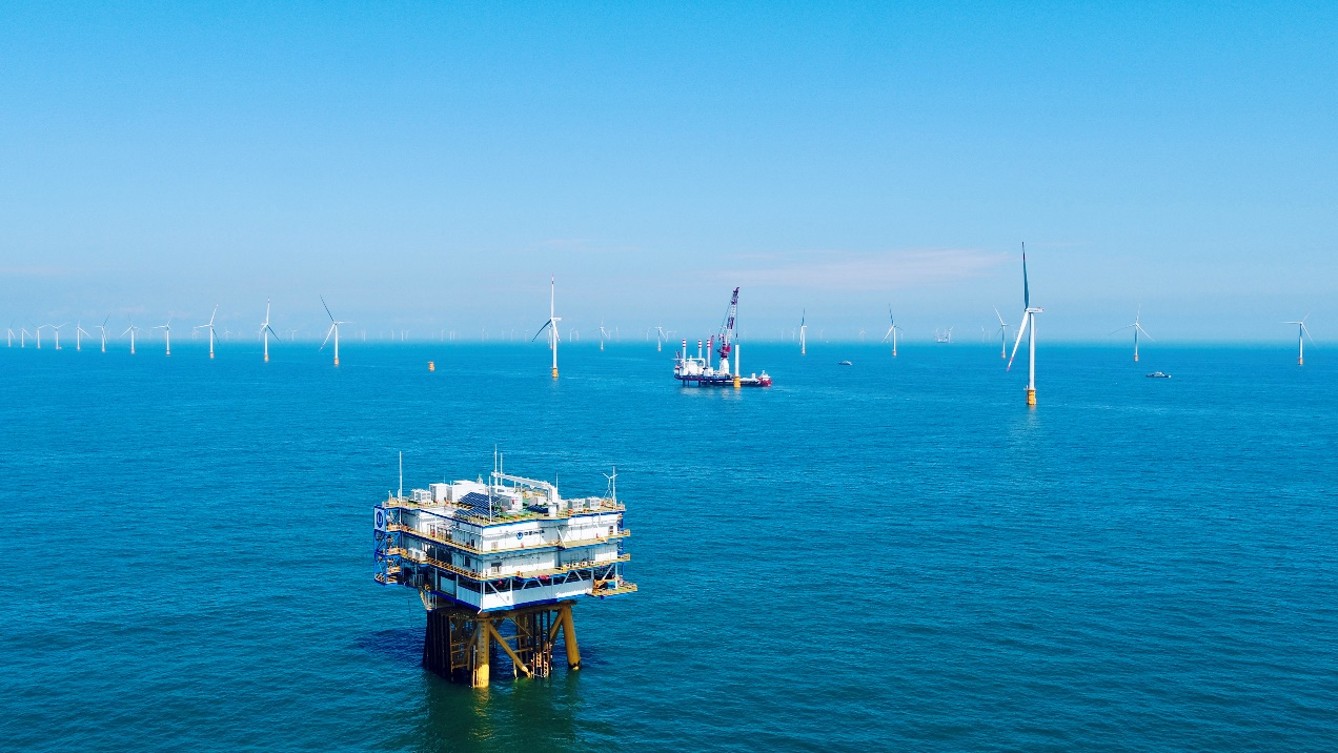
Opening photo: The Rudong offshore wind farm in China (Photo credit: Three Gorges )
Chinese Wind Energy Association
Download PDFIntroduction
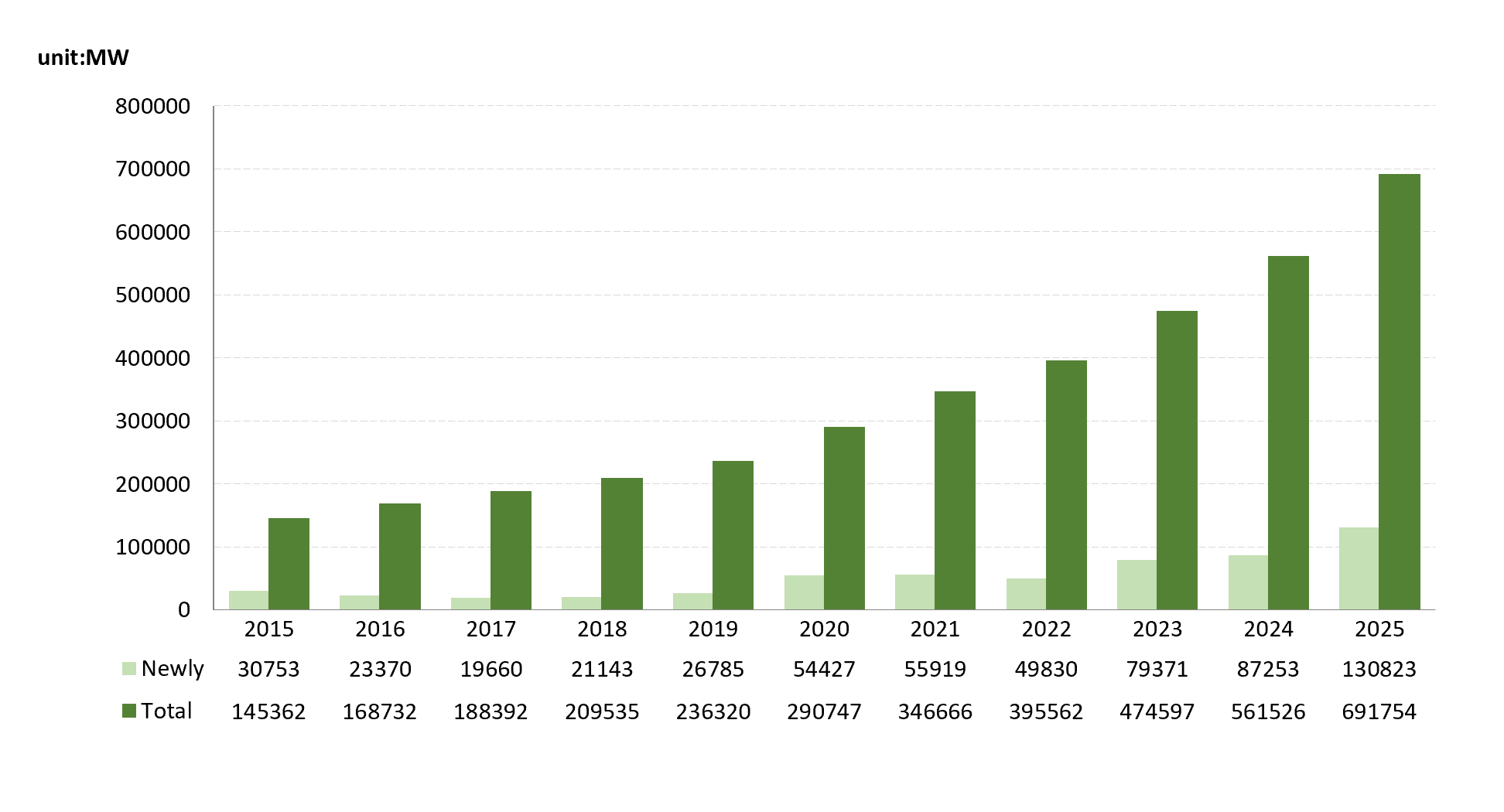
China continues to have the highest wind power capacity in the world in 2025. New wind power capacity of 130.8GW was installed representing a 49.9% increase from last year. Accumulated net capacity of in-service wind turbines increased to 691.7 GW. The newly added and cumulative wind power capacities respectively accounted for 50.9% and 22.9% of installed power capacities nationwide in 2025.
Wind power remains the third largest electricity generation source in China, following thermal and hydro-electricity sources. Wind-generated electricity totaled 1118.8 TWh, an increase of 12.8% over the previous year. Wind-generated electricity accounted for 10.8% of the total electricity generation, an increase of 0.7 percentage points over 2024.
In 2025, the Chinese government issued a series of policies and regulations to strengthen wind power development with multi-energy, vigorously develop wind and solar power generation focusing on deserts and Gobi areas, reduce wind curtailment, and promote the development of distributed wind power in rural areas. In addition, Chinese companies made progress in R&D, including onshore and offshore wind turbines enlargement and offshore floating wind energy generation demonstration project.
| Total (net) installed wind power capacity | 691.7GW |
| Total offshore capacity | 49.2GW |
| New wind power capacity installed | 130.8GW |
| Decommissioned capacity (by the end of 2025) | 0.59 (2.184) GW |
| Total electrical energy output from wind | 1118.8 TWh |
| Wind-generated electricity as a percentage of national electricity demand | 10.8% |
| Average national capacity factor | 20% |
| Target | 1300GW by 2030 |
| National wind energy R&D budget | N/A |
Highlights
- Total wind capacity surpassed 690GW
- Total offshore capacity exceeded 49GW, representing nearly 7.1% of total wind capacity
- Record high wind generation 1118.8TWh, 12.8% increase compared to 2024
- The largest onshore and offshore wind turbines installed in 2025 were 12.5MW and 26MW, respectively
Market Development
Targets and Policy
The main targets of the 14th Five-Year Plan for the Development of Renewable Energy (2012-2025) are: Renewable energy to account for more than 50% of the increase in primary energy consumption. The increase in electricity generated from renewable energy to account for more than 50% of the total increase in electricity consumption, and the electricity generation from wind and solar energy to be doubled. By 2025, the national total renewable energy consumption weight should be about 33 percent, non-hydropower consumption weight should be about 18 percent.
By 2030, China's carbon dioxide emissions per unit of GDP is expected to decrease by over 65% compared to 2005. The proportion of non-fossil energy in primary energy consumption is estimated to reach around 25%. Forest stock volume is expected to increase by 6 billion cubic meters compared to 2005. At this rate, the total installed capacity of wind and solar power generation will exceed 1200 GW.
The relevant policy measures taken to vigorously develop wind and solar power generation are:
Strengthen top-level design and anchor green development goals. President Xi Jinping proposed, at the United Nations Climate Change Summit in September 2025, that the total installed capacity of wind and solar power should reach more than six times that of 2020, striving to achieve 3600GW while the proportion of non-fossil energy in total energy consumption should exceed 30% by 2035. This sets a clear direction for the long-term development of wind power.
China promotes the full integration of new energy power into the electricity market, with electricity prices determined through market transactions, and put in place a supporting sustainable price settlement mechanism. In February 2025, the National Development and Reform Commission and the National Energy Administration issued the Notice on Deepening the Market-oriented Reform of On-grid Electricity Prices for New Energy and Promoting the High-quality Development of New Energy. This is an important institutional pillar supporting China’s energy transition and the goals of carbon peaking and carbon neutrality. The reform will exert a far-reaching impact on cost reduction and efficiency improvement for the new energy sector, stimulate the development of flexible regulating resources to build a new-type power system, and accelerate the development of a unified national electricity market.
China actively explores new models for the local consumption and utilization of new energy, including direct green power connection, zero-carbon industrial parks, and integrated development of source, grid, load and storage. In May 2025, the National Development and Reform Commission and the National Energy Administration issued the Notice on the Orderly Development of Direct Green Power Connection, to advance the local and on-site consumption of new energy and better meet enterprises’ demand for green power. In July, the National Development and Reform Commission, the Ministry of Industry and Information Technology, and the National Energy Administration jointly released the Notice on Launching the Construction of Zero-carbon Industrial Parks, to carry out low-carbon and zero-carbon transformation of various industrial parks in a planned and step-by-step manner. The list of the first 52 national-level zero-carbon industrial parks was announced in December.
China is promoting the transformation of new energy development, construction and operation models, with the goal of making integrated and coordinated development an important approach for new energy by 2030. In October 2025, the National Energy Administration issued the Guiding Opinions on Promoting the Integrated and Coordinated Development of New Energy, which defines the integrated and coordinated development of new energy in three aspects: multi-dimensional integrated development of new energy, coordinated development between new energy and various industries, and diversified non-power utilization of new energy, with corresponding policy measures proposed for each. It aims to foster a more resilient, efficient and sustainable upgraded model of new energy development.
Progress and Operational Details
In 2025, China installed 130.8GW of new wind power capacity (exclusive of Taiwan). This accounted for 75% of the new global wind capacity for the year. The accumulated wind power capacity in China reached 691.7GW (figure 1), accounting for 51% of the wind power capacity worldwide, maintaining the highest wind power capacity in the world.
In 2025, the new installation of offshore wind capacity is about 5.6GW, representing a 5.1% decrease from last year. The cumulative installation exceeded 49.2GW.
The total capacity of all decommissioned wind turbines throughout the years is 2184MW with additional 590MW decommissioned in 2025.
Factors Affecting Growth and Work to Remove Barriers
In 2025, the new installation was record high, and the power grid came under enormous strain. NEA has taken multiple measures to ensure the grid integration of wind power and improve the consumption of green electricity.
RD&D Activities
National RD&D Priorities and Budget
In 2025, the national RD&D still focused on building the multi-energy complementary clean energy bases, including the integration development of wind, solar, hydro, ocean energy, clean coal-fired plants, grid, load and energy storage projects, power to X, desert and Gobi wind power, deep-sea offshore wind power and several transmission channels, the new type of wind turbines and key components, and medium voltage, direct current, low frequency technologies, etc. The relevant RD&D actions had achievements, and the investments were mainly done by the developers, manufacturers, and research bodies.
National Research Initiatives and Results
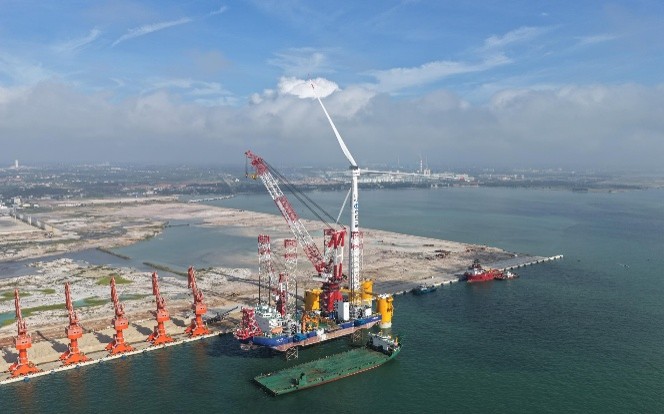
The research and manufacturing of the super large wind turbines and their main components have made great achievements. The 15MW onshore wind turbines were put into operation. The 16MW with 252-meter rotor diameter floating wind turbine jointly developed by Goldwind Science & Technology and China Three Gorges Corporation was successfully assembled in Beihai, Guangxi. (figure 2).
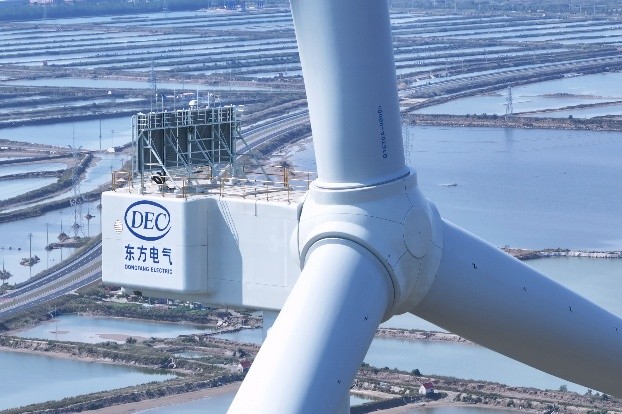
The first 26MW-252 offshore wind turbine made by DEC was installed, marking a significant milestone in the renewable energy sector (figure 3). This advanced turbine represents a major leap forward in wind power technology.
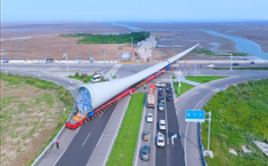
The longest blade of 153m (figure 4), the biggest main gearbox and main bearing for 26MW wind turbine, the highest tower of 190m, and the rotor blade recycling machine, etc., represent great achievements.
At the same time, software R&D to meet the demands of multiple scenarios wind farm planning and design has achieved greater success. To tackle core industry challenges—widely varying flow field coupling mechanisms, poor model generalization under volatile atmospheric conditions, and the need to balance multiple planning constraints—Hohai University launched the “Hefeng Zhiyuan” Platform after nearly 20 years of development, achieving three breakthroughs:
(1) High-Precision Multi-Scenario Flow Field Modeling: Developed high-fidelity and self-similarity flow models for flat terrain, complex terrain, offshore, and large-scale bases. Innovations in microscale coupled nesting algorithms and multi-principle flow field superposition boost prediction accuracy by over 5%, while greatly improving computational efficiency and cross-scenario generalization.
(2) Multi-Objective Adaptive Optimization: Intelligent algorithms for multi-scenario micro siting and path optimization have been developed, and a novel macro-micro collaborative method has been established. This increases energy yield by more than 2% while cutting construction costs under multiple constraints.
(3) Industry's First Integrated Efficient Design Platform: Fully consolidates wind resource assessment, macro/micro-siting, road/cable routing, economic analysis, noise/shadow flicker assessment, and post-evaluation into one seamless workflow. With Web GIS visualization and one-click layout, it improves overall design efficiency by 40%.
Deployed by 30+ design institutes and widely adopted by major power groups, the platform delivers substantial economic and ecological benefits.
Test Facilities and Demonstration Projects
The full-scale test benches for blades more than 180m long have been put into operation. Test benches for the whole nacelles of more than 30MW wind turbines are under construction by the industry and independent third parties, such as CGC.
Collaborative Research
By the end of 2025, CWEA had arranged for 28 domestic wind power companies, research institutes, and universities to attend IEA Wind TCP Tasks including the ended or in progress:
- Task 11 Base Technology Information Exchange
- Task 19 Wind Energy in Cold Climates
- Task 25 Design and Operation of Power Systems with Large Amounts of Wind Power
- Task 27 Small Wind Turbines
- Task 29 Mexnext: Analysis of Wind Tunnel Measurements and Improvement of Aerodynamic Models
- Task 30 Offshore Code Comparison, Collaboration, Continued, with Correlation, unCertainty (OC3-OC6)
- Task 31 Benchmarking of Wind Farm Flow Models
- Task 32 Lidar Systems for Wind Energy Deployment
- Task 33 Reliability Data: Standardizing data Collection for Wind Turbines
- Task 35 Full-Size Ground Testing for Wind Turbines and Their Components
- Task 36 Forecasting for Wind Energy
- Task 37 Systems Engineering
- Task 39 Quiet Wind Turbine Technologies
- Task41 Enabling Wind to Contribute to a Distributed Energy Future
- Task42 Wind Turbine Lifetime Extension Assessment
- Task44 Farm Flow Control (joined in 2024)
- Task48 Airborne Wind Energy (joined in 2024)
- Task49 Integrated Design of floating wind Arrays (IDEA) (joined in 2022)
- Task51 Forecasting for the Weather Driven Energy System (confirmed in 2025)
- Task52 Large-Scale Deployment of Wind Lidar (joined in 2023)
- Task56 OC7 (joined in 2024)
IEA Wind Tasks' participants from China actively joined the collaboration research, combined with their company's needs, on the relevant Tasks and achieved progress winning industry praise.
Impact of Wind Energy
Environmental Impact
In 2025, wind-generated electricity totaled 1118.8 TWh, which saved about 349.17 million tons of standard coal and reduced the emissions of carbon dioxide by 1066.72 million tons. It plays a significant role in reducing air pollution and controlling greenhouse gas emissions, supporting the achievement of the “30·60”targets of peak carbon emissions by 2030 and carbon neutrality in 2060.
Developing a total of 450GW in three hatches of wind and solar power in the desert and Gobi areas will help improve the ecological environment. Developing wind power combined with local cultural, environmental requirements and restoration of greenery, soil and water conservation, and roads are the cardinal principles to maintain the ecological environment.
Economic Benefits and Industry Development
In 2025, new installation capacity reach about 130.8GW, including about 5.6GW of new capacity of offshore wind power. With land-based wind power investment of CNY 5,050/kW (EUR 668.62/kW; USD 691.35 /kW) and offshore wind power investment of CNY 13,700/kW (EUR 1,813.88/kW; USD 1,875.53/kW), the total investment in wind energy in 2025 reached more than CNY 737 billion (EUR 97.6 billion; USD 100.9 billion).
The development of the wind energy industry will markedly enhance the development of related industries and increase employment. In 2025, about 15 jobs were created for every 1 MW of installed wind power capacity, and it is estimated that more than 1.9 million people were employed in the wind power industry through 2025. Meantime the supply chains of large wind turbines have been becoming increasingly more mature and comprehensive.
Next Term
The development of wind power has become an important part of China's green development. The domestic wind power industry has made great achievements in both onshore and offshore wind developments. It is expected that during the 15th Five-Year Plan period (2026-2030), desert and Gobi wind power, distributed wind power, and offshore wind power will still be the three main forces of wind power development and construction.
In coastal areas local consumption of electricity will be promoted and the imbalance of integrated energy consumption between east and west regions will be reduced. With lower power prices, the end market demand will grow substantially. CWEA will continue to do its best to organize national research efforts and related activities of IEA wind.
References
[1] CWEA (2026) China Wind Power Installation Capacity Statistics 2025
[2] GWEC (2026) Global Wind Report 2025
Authors
Authors: WANG Tongguang, DU Guangping and HE Jieying, Chinese Wind Energy Association (CWEA), China
Contact via email: dugp@cgc.org.cn